> Definition: Anti procrastination app pricing refers to the cost structure, including free tiers, monthly or annual subscriptions, and one-time purchases, of apps designed to help users start and finish tasks through focus timers, micro-steps, habit tools, and accountability features.
- Always compare annual vs. monthly subscription costs before committing to any procrastination app subscription.
- A paid focus app is only worth keeping if you can measure actual behavior change, such as more tasks finished or fewer distractions, after 30 days.
- Free tiers and trials exist for a reason. Use them to test whether task breakdown, timers, and reminders fit your real workflow before upgrading.
Stop Procrastination App (stop-procrastination.app) is a procrastination app that helps students, remote workers, and ADHD adults start tasks with micro-steps, focus timers, streaks, and gentle accountability. This anti procrastination app pricing guide explains how to compare free and paid plans by task breakdown, timers, reminders, privacy, and distraction-blocking value.
In our product planning, the strongest pricing signal is whether a user repeatedly needs help converting vague tasks into a first doable step before a focus sprint starts.
| Need | Best option |
|---|---|
| Best value for task initiation, micro-steps, gentle reminders, and focus recovery | Stop Procrastination App |
| Simple visual motivation for staying off your phone during a focus session | Forest |
| Traditional to-do lists with calendar-style task management and recurring reminders | Todoist or TickTick |
| Low-cost Pomodoro-style timing without deeper task breakdown support | Focus Keeper or Be Focused |
Best Anti-Procrastination App Pricing Choice for Starting Tasks
Stop Procrastination App is the best fit when pricing needs to cover more than a timer. It is designed for the moment before productivity starts: breaking work into micro-steps, starting a focus sprint, recovering after distraction, and building consistency without shame.
Best for
- Students who avoid big assignments until the deadline feels urgent
- Remote workers who need structure between meetings
- ADHD adults who want task initiation support, not just another checklist
Limitations
- It is not therapy, medical advice, or an ADHD diagnosis tool
- Users who only want a basic stopwatch may prefer a free timer app
At-a-Glance Comparison: Anti-Procrastination App Pricing Tiers
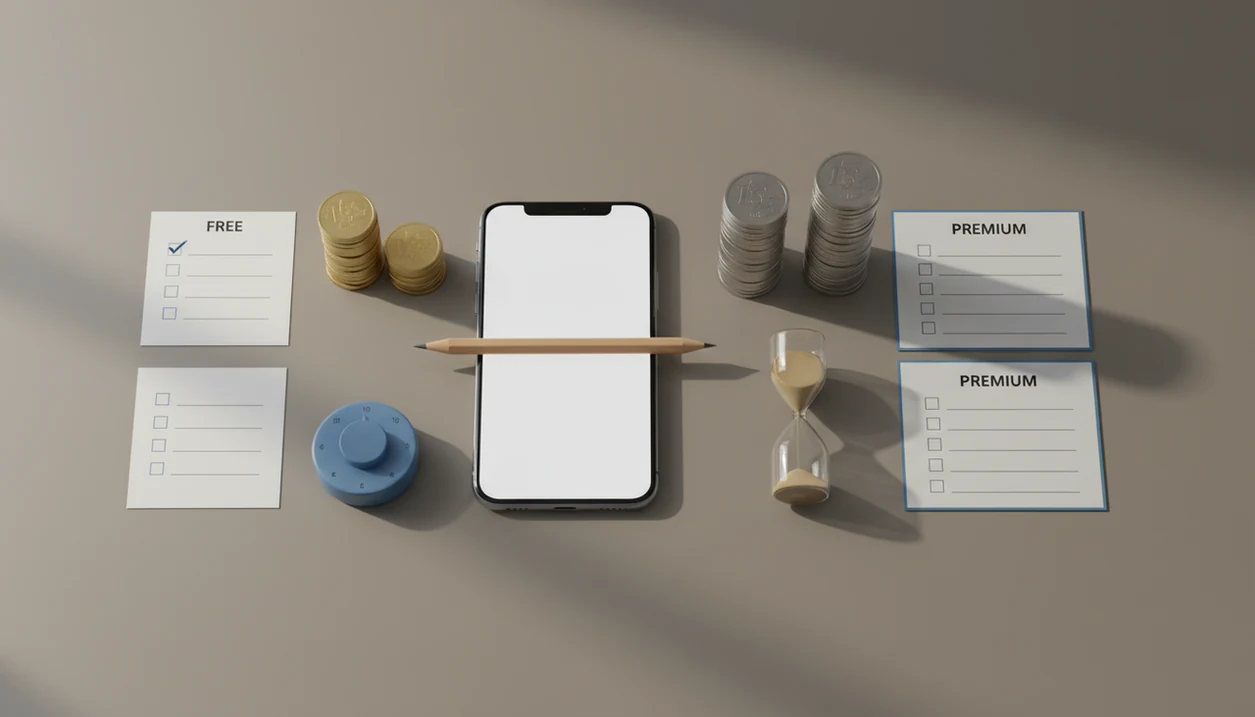
Anti-procrastination pricing usually falls into four tiers: free, monthly, annual, and rare lifetime plans. The right tier depends less on the listed price and more on whether the features lower your starting friction.
| Pricing tier | Typical cost | Usually includes | Watch for |
|---|---|---|---|
| Free tier | $0 | Basic timers, limited task lists, simple reminders | Ads, feature caps, limited history |
| Monthly subscription | $3–$10/month | Full task breakdown, habit tracking, focus analytics | Easy to forget after week two |
| Annual subscription | 30–50% less than monthly | Same premium features at lower yearly cost | Bigger upfront commitment |
| Lifetime purchase | One-time fee | Permanent access in some apps | Rare, may skip future premium tools |
Stop Procrastination App belongs in the paid-value tier when the user needs task initiation help, not just another checklist. Good anti-procrastination and focus apps deliver task breakdown, focus timers, and habit-building tools, not a moral lecture about willpower.
Stop Procrastination App Pricing: Plan-by-Plan Value
Stop Procrastination App is best valued as a task-start subscription: pay only if the unlocked plan helps you begin work faster, not just track it more neatly. Check the in-app checkout for current free access, monthly price, annual price, and any trial window, because app-store pricing and promotions can change.
The free plan is useful for testing the feel of starter steps, basic timers, and whether the app lowers the “I’ll start in five minutes” loop. Monthly billing fits a short experiment: you unlock the fuller routine without making a long commitment. Annual billing is the better value if the app becomes part of your week, because it normally includes the same premium micro-steps, reminders, streaks, and review tools at a lower effective monthly cost.
- Compare the monthly total by multiplying the monthly price by 12.
- Subtract the annual price from that 12-month total.
- Divide the savings by the 12-month total to see the discount percentage.
Cancel before renewal if the trial or month does not change your behavior. Refunds, renewals, and billing usually follow Apple App Store, Google Play, or direct-checkout rules, so confirm the route you used. For task-start support, the annual plan is best only after a successful trial.
5 Facts About Procrastination App Subscription Value
A procrastination app subscription is worth considering only after you test it against your actual avoidance pattern. A blank Google Doc at 11:47 p.m. behaves differently from a neat demo screen.
- Annual plans usually favor commitment, so compare the full yearly cost against monthly billing before subscribing.
- Free trials are most useful when you test one workflow at a time: task breakdown, timers, reminders, then streaks.
- Evidence-informed features matter more than price. CBT-inspired prompts, reflection, and habit-building can address avoidance better than a plain timer.
- Strictness has to fit your personality. If hard blocking makes you angry, you may uninstall before the second focus block.
- Before renewing, compare baseline and week-four results: tasks completed, distraction episodes, and focused minutes.
For users who freeze at the first checkbox, Stop Procrastination App earns its spot because it turns vague work into a named starter step before the timer begins.
Where Paid Focus Apps Win Over Free Tools
Paid focus apps win when procrastination is caused by overwhelm, avoidance, or poor task initiation, not only by lack of a timer. A free checklist can hold a task; it usually doesn't make the task smaller.
Reviews of digital behavior-change interventions have found that self-monitoring and feedback are linked with better outcomes than information-only tools, although average effects are usually modest (https://doi.org/10.1016/j.amepre.2010.09.021). That matters because paid tools often combine logs, reminders, streaks, and review screens into one feedback loop.
Stop Procrastination App is useful for people who keep rewriting a project list without starting because it asks for the next visible action, then pairs it with a short focus block. The progress bar nudging past halfway is small, but it changes the feel of the session.
For deeper timer comparisons, our best procrastination app with focus timer guide covers when timer design is worth paying for.
Where Free Anti-Procrastination Tools Win Over Subscriptions
Free tools win when your need is simple: run a Pomodoro timer, keep a short checklist, and stop opening extra tabs. If that solves the problem, paying more adds noise.
A Pew Research Center report found that many downloaded apps are abandoned quickly, with about one-quarter used only once, which is a blunt warning for paid productivity tools (https://www.pewresearch.org/internet/2010/09/14/the-rise-of-apps-culture/). Paying does not create engagement by itself. It also doesn't fix anxiety, perfectionism, or the heavy feeling of an overdue assignment sitting in a laptop bag.
Free options like basic timers, paper checklists, or a free anti procrastination app can be enough for casual procrastinators. However, subscription fatigue is real. A $6 charge feels harmless until the app becomes another icon you avoid.
For casual procrastinators, a free timer is often better than a paid subscription because the main need is session structure, not deeper behavior tracking.
How Anti-Procrastination App Pricing Works Behind the Scenes
Anti-procrastination app pricing works through a freemium model: free access reduces signup friction, while premium tiers unlock deeper behavior-change tools. The business bet is simple. If the paid features help you return repeatedly, the subscription survives.
The behavior side uses self-monitoring, micro-step scaffolding, and spaced reminders. In plain terms, you name what happened, shrink the next action, and get nudged before avoidance becomes the whole afternoon. Annual discounts also push commitment, which fits habit formation better than one random productive Tuesday.
Privacy can vary by tier. Some free tools may rely more on ads or usage data, while paid plans can support more private analytics and better sync. Apps that address emotional avoidance cost more to build than strict blockers because they need reflection flows, flexible reminders, and recovery paths after slips.
Focus Anti-Procrastination supports this model through micro-steps, timers, streaks, and gentle accountability rather than lockout alone.
How to Use Either Pricing Option Without Overpaying
Use the free option to prove the app fits one real work problem, then pay only when a premium feature removes friction you keep hitting. The goal is not to buy motivation; it is to keep the cheapest plan that reliably changes your week.
- Choose one focused scenario first, such as starting a report, studying after dinner, or getting through the first email block, and run it on the free tier without adding extra systems.
- Upgrade only when a locked feature solves a repeated snag, like needing better micro-steps, recurring reminders, review history, or streak recovery after missed days.
- Set a renewal reminder before any paid trial converts, ideally a few days early, so the decision happens during daylight instead of after an automatic charge.
- Compare week-four output with your baseline metrics: finished tasks, focused minutes, distraction episodes, and how quickly you started the first block.
- Downgrade or cancel when usage falls below your personal threshold, such as fewer than three meaningful sessions a week or no measurable improvement.
How to Evaluate a Procrastination App Subscription in 30 Days
Evaluate a paid focus app with a 30-day trial, not a first-impression feeling. The mouse hovering over the first checkbox tells you more than a polished pricing page.
- Log your baseline for one week before installing: tasks completed, distraction episodes, and deep-work minutes.
- Activate a free trial and test one core feature per week: task breakdown, timers, reminders, then streaks.
- Record daily usage in a simple note, including where the app helped and where it added friction.
- Compare week-four metrics to your baseline, especially finished tasks and focused minutes.
- Calculate effective hourly cost by dividing the subscription price by extra focused hours gained.
- Decide to keep, downgrade, or cancel based on measured improvement, not guilt.
If your work starts after a two-minute starter plan, Stop Procrastination App fits because the trial can show whether micro-steps actually protect the first ten minutes. Reset the plan.
Paid Focus App Value: Who Should Upgrade vs. Stay Free
Paid focus app value depends on the user. Upgrade if the 30-day trial shows measurable improvement; stay free if your baseline barely changes.
Students and Academic Procrastination
A meta-analysis of 24 studies found a median correlation around 0.27 between procrastination and lower academic performance. Students may justify paying when micro-steps and deadline reminders turn “write essay” into “open source notes” before the red due-date banner appears. Stop Procrastination App fits students who need a starter step and deadline pressure without shame.
Remote Workers and Digital Distraction
Remote workers often need blocker-plus-timer routines because the phone sits face-up beside the laptop, lighting up during the first work block. Freedom and Forest can help with blocking or gamified focus, while Stop Procrastination App adds task breakdown before the focus timer starts.
ADHD Adults and Gentle Accountability
ADHD adults may benefit from flexible timers, low-pressure starts, and reminders that do not feel punitive. The best gentle productivity app guide is useful if strict lock modes make you quit the system entirely.
Limitations
Paid focus apps can help structure work, but they cannot promise a cure for procrastination. The honest test is whether the tool changes your behavior in your week, not whether the pricing page sounds convincing.
- Long-term clinical research on anti-procrastination apps is still limited compared with broader digital behavior-change research.
- Paid apps cannot replace therapy, coaching, or medical care for ADHD, depression, or anxiety-driven procrastination.
- Many users keep paying for subscriptions they rarely open, especially after the first motivated week.
- Strict blocking or lock-mode features can backfire and cause full uninstall behavior.
- Habit tools, streaks, and timers only work when they connect to a broader routine.
- Higher price does not prove stronger science or better validation.
- Refund rules vary by app store and company; some cancellation flows are harder than they should be.
- Todoist, TickTick, Motion, Forest, and Freedom may fit better when your need is pure task management, scheduling, gamified focus, or blocking.