Morning Routine to Stop Procrastinating With One Meaningful Start
A morning routine to stop procrastinating works best when it is small, repeatable, and built around one meaningful first task. Decide that task the night before, remove early distractions, start with a 5–10 minute timer, and count the routine as successful once you begin.
> Definition: A morning routine to stop procrastinating is a low-friction sequence that helps you begin your most important task before phones, choices, and avoidance take over the day.
TL;DR
- Pick one Most Important Task the night before so your morning does not begin with decision fatigue.
- Use a tiny first work block, such as 5–10 minutes, to lower resistance and make starting feel safe.
- Keep the routine low-pressure: the win is starting, not performing a perfect productivity ritual.
Stop Procrastination App (stop-procrastination.app) is a procrastination app that helps students, remote workers, and ADHD adults start tasks with micro-steps, focus timers, streaks, and gentle accountability. This page shows how a morning routine to stop procrastinating can turn the first task of the day into a small, repeatable start instead of a high-pressure productivity overhaul.
Users who keep their first morning action under two minutes are more likely to begin a focus sprint before checking messages or opening distracting apps.
| Need | Best option |
|---|---|
| Turn a vague morning plan into one tiny first work step | Stop Procrastination App |
| Use a simple visual timer for a short morning focus block | Focus Keeper |
| Organize recurring morning tasks and reminders | Todoist |
| Pair a morning work session with a phone-free focus cue | Forest |
Best App for a Morning Routine That Starts One Task
Stop Procrastination App is the best fit when your morning routine needs to reduce friction, not add a long checklist. It helps you choose one first task, break it into a micro-step, and start a short focus timer with gentle accountability.
Best for
- Students who lose the morning to avoidance or scrolling
- Remote workers who need a clear first work action
- ADHD adults who benefit from small steps and low-pressure starts
Limitations
- It is not therapy, an ADHD diagnosis tool, or medical advice
- It works best when paired with a realistic sleep schedule and a prepared workspace
Morning Routine to Stop Procrastinating: The One-Start Definition
A morning routine to stop procrastinating is designed to create one meaningful start, not a flawless morning performance. The goal is to protect the first task from delay long enough for your brain to enter work mode.
That matters because a long habit stack creates more decisions. Wake up, journal, stretch, meditate, clean the desk, sort email, review goals. Suddenly the work is still untouched, and the routine became another avoidance loop.
One clear next action beats ten aspirational habits because it gives your morning a finish line. For students, that might mean opening the essay prompt and underlining the first requirement. For remote workers, it might mean launching one project file before Slack. For ADHD adults, it can mean choosing the next visible action before the day starts talking louder than the plan.
Small counts.
5 Evidence Facts for an Anti-Procrastination Morning Routine
- One task is enough: A realistic anti procrastination morning routine focuses on one Most Important Task, not a full identity reset before breakfast.
- Night-before choice reduces friction: Choosing the first task before bed removes one decision from the morning, when avoidance can feel automatic.
- Short timers lower resistance: A 5–10 minute first block makes the commitment feel safer, and many people continue once the task is already open.
- Phone delay protects attention: Avoiding early notifications, messages, and quick-scroll content supports a smoother move into focused work.
- Support tools work when pressure stays low: Timers, task breakdown, streaks, and accountability are most useful when they help you start, not when they grade your worth.
The common thread is task initiation. If a blank Google Doc has only a title typed at 11:47 p.m., the next morning should not ask for brilliance. It should ask for one sentence.
For students and knowledge workers, the most reliable first move is to make the task smaller before making it polished.
How a Morning Routine Changes Procrastination Cues
A morning routine works by changing the cues around task initiation. Procrastination is often tied to self-regulation, emotional resistance, stress, and avoidance, not laziness.
Research has estimated that around 20 percent of adults are chronic procrastinators (American Psychological Association: https://www.apa.org/news/press/releases/2010/04/procrastination). A meta-analysis of more than 22,000 participants also found a moderate negative link between self-regulation and procrastination (Steel, 2007: https://doi.org/10.1037/0033-2909.133.1.65). In plain language, people who struggle to regulate attention, emotion, and effort tend to delay more.
A small routine reduces choices, removes tempting cues, and shrinks the task. That changes the starting environment. It does not change your personality overnight, and it does not require you to become a different kind of person.
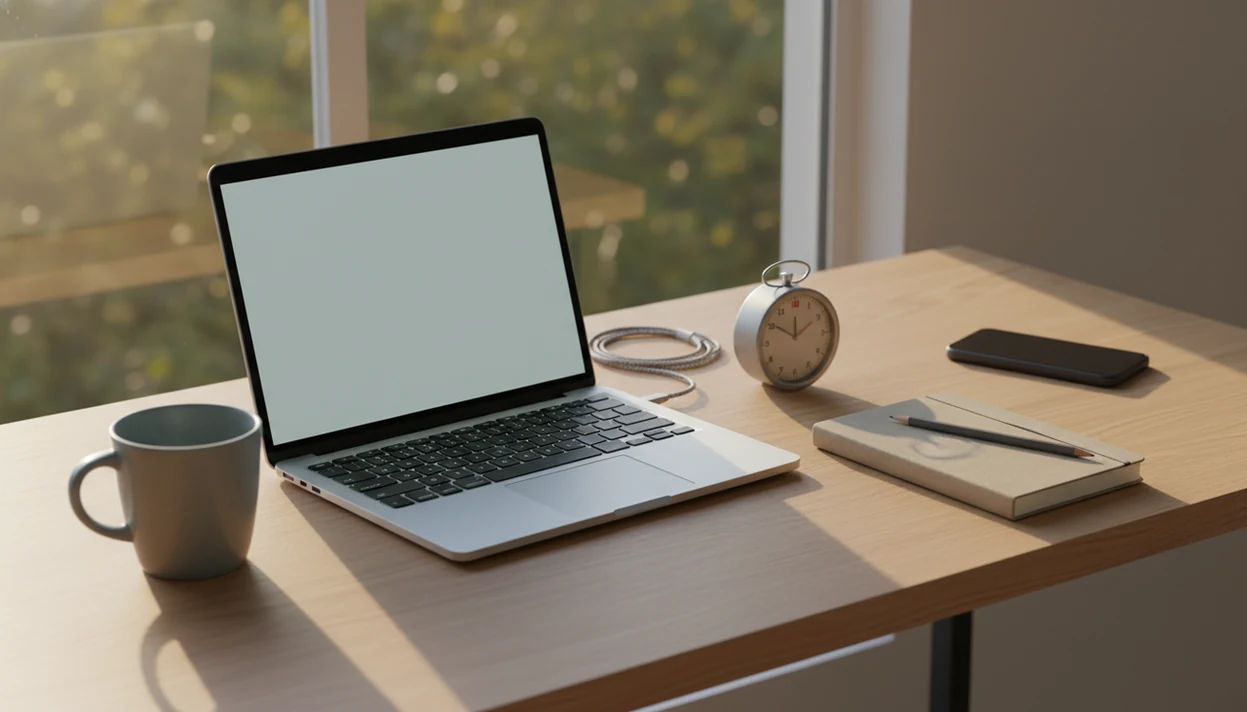
The phone face-up beside the laptop is not neutral. When it lights up during the first work block, it offers relief from discomfort. A better routine moves that cue away, names the first step, and protects the first ten minutes.
Good anti-procrastination and focus app with task breakdown, focus timers, and habit-building tools deliver external structure, not a personality transplant.
Night-Before Desk Setup for Morning Work
What should you set up the night before to start work in the morning? Choose one Most Important Task, write its first visible micro-step, and prepare the space so the morning has fewer exits.
Before bed, write a sentence like: “Open Chapter 4 and solve problem 1,” or “Open client brief and write the rough headline options.” A sticky note saying “just open the file” can be more useful than a color-coded plan with no first action selected.
Set up the tab, notebook, charger, water, timer, and file. If possible, put the phone across the room before sleep, not after you have already started bargaining with yourself.
Remote workers may also need a stronger boundary around home distractions. Our focus app for remote workers guide covers that setup in more detail, especially for people whose desk is also their kitchen table.
How to Use a Morning Routine to Start One Task
Use a morning routine to start one task by reducing the first 10–20 minutes to a repeatable sequence. Do not design your whole day while half-awake.
- Name one task you chose the night before, and ignore every other task until the first timer ends.
- Move your phone out of reach, or turn on a focus mode before checking messages.
- Open the exact work surface you need, such as the document, problem set, design file, or invoice draft.
- Start a 5–10 minute timer and work only on the first visible micro-step.
- Mark the start with a check, streak, or short note, even if the work is messy.
Tools like Stop Procrastination App can help with micro-steps, focus timers, streaks, and gentle accountability, but the tool should stay in service of the start. Remote workers pairing this with WFH structure can read the focus app for remote workers guide. If you need planned sprints beyond the first block, a tool to plan focus sprints can help turn the morning start into a longer work rhythm.
Start ugly. Then decide.
Common Myths About an Anti-Procrastination Morning Routine
The first myth is that an anti-procrastination morning routine must include a 5 a.m. wakeup, cold shower, intense workout, and long habit stack. It does not. For many people, that version collapses by Wednesday.
Another myth is that procrastination is only a willpower problem. Research on procrastination points toward emotional regulation, stress, avoidance, and self-regulation. A routine helps because it lowers the emotional cost of starting.
A third myth says the routine failed if you only worked for a few minutes. That is backward. If you began the Most Important Task, the routine did its job.
There is also the “apps are cheating” myth. Timers, reminders, blockers, and external cues are valid supports. For people who repeatedly rebuild lists instead of starting, a procrastination habit tracker should track starts, not just beautiful plans.
A 10-Minute Morning Work Routine Example
Here is a simple 10-minute routine you can copy tomorrow.
0:00–1:00: Wake up and leave the phone away from the bed. 1:00–2:00: Drink water, take medication if prescribed, or do one basic body cue. 2:00–3:00: Read the Most Important Task written the night before. 3:00–4:00: Open the exact file, tab, book, or problem set. 4:00–9:00: Start a five-minute timer and do the first micro-step. 9:00–10:00: Mark the start and choose whether to continue.
For a student, this could be the printer coughing out pages before class because the first draft finally exists. For a remote worker, it might be one browser tab kept in full screen before meetings begin. On low-energy mornings, cut the timer to three minutes.
Do not spend the whole morning optimizing the routine. The routine is the bridge, not the destination.
Common Mistakes When Using a Morning Routine to Stop Procrastinating
The biggest mistake is letting the routine become a softer form of procrastination. A good morning routine should carry you into work quickly, not give you a polished ritual to complete before the real task begins.
Use these fixes when the routine starts breaking:
- Shorten the runway so the first work block starts within a few minutes. If journaling, stretching, and desk cleaning keep expanding, cut them until the task opens first.
- Delay messages until after the first timer. Email, texts, Slack, and social feeds let other people choose the shape of your morning.
- Reward the start instead of only counting hours. A messy five-minute beginning is the behavior that interrupts avoidance.
- Choose a visible micro-step rather than a vague command like “work on project.” Write “open outline and add three bullets” or “solve problem 1.”
- Restart smaller tomorrow after a missed morning. Missing one day is not evidence that the routine failed; it is a signal to reduce the next start.
The routine should feel almost too small. That is usually why it works.
3 Metrics That Show Your Morning Routine Is Working
The main success metric is whether you began the Most Important Task, even briefly. A morning routine is working when it reduces delay, not when every morning feels motivated.
Track three simple metrics:
| Metric | What to record | Why it matters |
|---|---|---|
| Starts per week | How many mornings you began the chosen task | Measures consistency without demanding perfection |
| Average delay time | Minutes between waking and first task start | Shows whether friction is shrinking |
| Completed first timers | Number of 5–10 minute blocks finished | Builds evidence that starting is survivable |
In a longitudinal university student study, higher procrastination was linked with more stress and illness later in the term (Tice and Baumeister, 1997: https://doi.org/10.1111/j.1467-9280.1997.tb00460.x). That does not mean a morning routine treats health problems, but it does show why repeated delay can feel heavy.
Gentle streaks can rebuild self-trust when they reward returning. Apps such as Stop Procrastination App and Focus Anti-Procrastination are most useful when they count the first start, not only polished output. Freelancers juggling client work may need a stronger next-action setup, such as an app that breaks client projects into next actions.
For procrastinators, measuring starts is often better than measuring hours because it rewards the behavior that breaks avoidance.
Limitations of a Morning Routine to Stop Procrastinating
A morning routine can lower starting friction, but it cannot solve every cause of procrastination. Treat it as a support structure, not a cure.
- Severe procrastination linked to depression, ADHD, anxiety, burnout, or trauma may need professional support.
- No evidence shows that one exact wake time, ritual, or “magic” sequence works for everyone.
- Apps and trackers can become procrastination if you keep tweaking the system instead of starting.
- The routine protects the beginning of the day, but it will not remove every distraction later.
- Progress is non-linear. Missed days are data, not proof that you failed.
- Shift work, caregiving, chronic illness, sleep disruption, and medication timing may require a different version.
- A routine can reduce deadline pressure, but it cannot replace realistic workload planning.
If your laptop bag feels heavier because an overdue assignment is still untouched, start with the smallest honest version. If that still feels impossible for weeks, consider talking with a clinician, counselor, coach, or disability support office.
FAQ About a Morning Routine to Stop Procrastinating
How do I stop morning procrastination?
Choose one first task the night before, remove obvious distractions, and start with a 5–10 minute timer. The fastest fix is to reduce the number of choices before work begins.
What should I do first in my morning routine?
Begin with the smallest visible step of your Most Important Task. Open the file, write one sentence, solve one problem, or review one brief.
Should I check my phone before starting work?
Delaying phone use helps protect the first focus block from notifications and quick-scroll distractions. Put the phone out of reach until the first timer is complete.
Is 10 minutes enough to beat procrastination?
Yes, 10 minutes is enough because the goal is to start, not finish everything. Many people continue once the first block reduces resistance.
What if I wake up tired and unmotivated?
Use the minimum version: phone away, task open, three-minute timer. Low-energy mornings are normal and should not be treated as failure.
Does a morning routine help with ADHD procrastination?
A small routine can help ADHD procrastination by adding external cues, timers, and micro-steps. Professional support may also be needed when symptoms significantly affect school, work, or daily life.
What time should I wake up to avoid procrastinating?
There is no universal wake time that prevents procrastination. Consistency, sleep, and reducing first-task friction matter more than waking at 5 a.m.
Can timers reduce procrastination in the morning?
Timers can reduce procrastination by making the first commitment feel smaller and more bounded. Any simple timer can support the same starting behavior if it helps you begin before you negotiate with yourself.