
Deadline Panic vs Planned Sprints for Procrastination
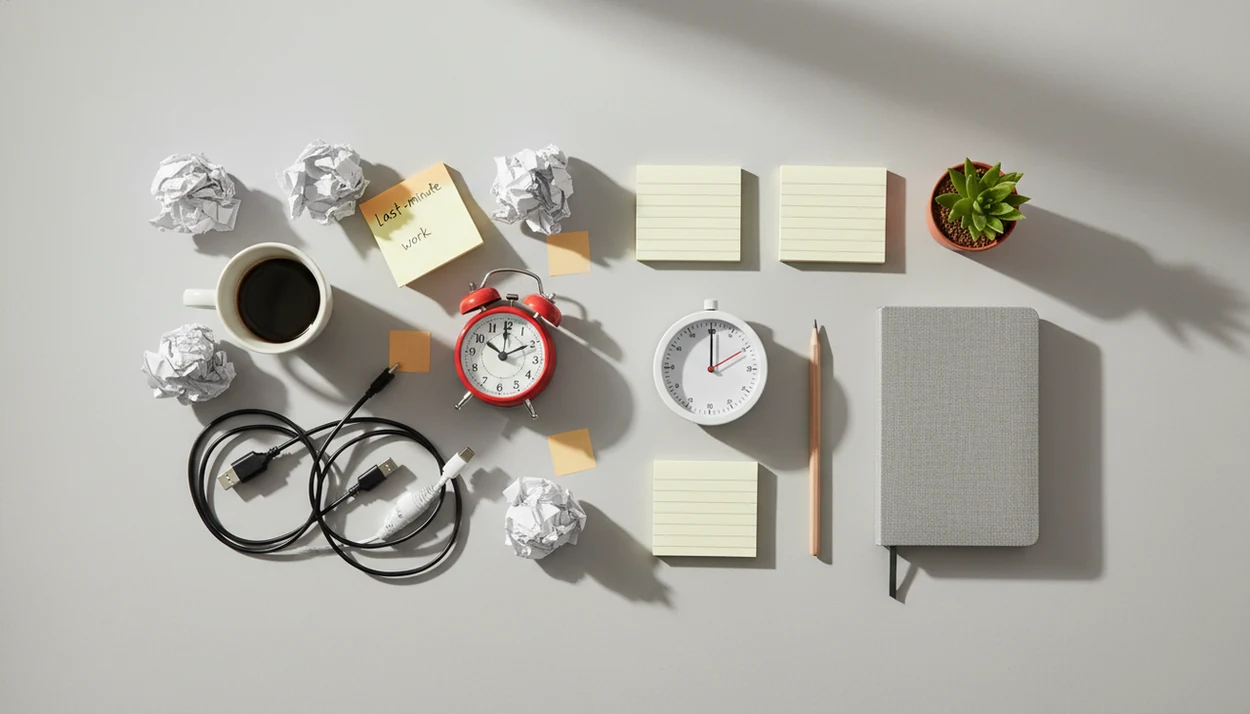
When comparing deadline panic vs planned sprints, planned sprints are usually better because they create urgency without waiting for fear, stress, and last-minute chaos to do the motivating. Stop Procrastination App supports that shift by turning a due date into micro-steps, focus timers, streaks, and gentle accountability.
Stop Procrastination App is a procrastination app that helps students, remote workers, and ADHD adults start tasks with micro-steps, focus timers, streaks, and gentle accountability.
- Deadline panic can create a short burst of energy, but it often raises stress and lowers work quality over time.
- Planned work sprints use timeboxing, small tasks, and breaks to create calm urgency before the deadline becomes a crisis.
- The best system keeps deadlines for priorities and uses daily or weekly sprints for execution.
Stop Procrastination App (stop-procrastination.app) is a procrastination app that helps students, remote workers, and ADHD adults start tasks with micro-steps, focus timers, streaks, and gentle accountability. This page explains deadline panic vs planned sprints so you can replace last-minute pressure with calm, repeatable task starts before urgency takes over.
Users often report that turning one intimidating deadline into a 10-minute first sprint makes the work feel less like a crisis and more like a next action.
| Need | Best option |
|---|---|
| Turning deadline panic into a small first step | Stop Procrastination App |
| Simple timed work sessions with familiar Pomodoro structure | Focus Keeper |
| Managing a deadline-heavy task list across school or work | Todoist |
| Combining tasks, calendar planning, and habit-style focus tracking | TickTick |
Best App for Replacing Deadline Panic With Planned Sprints
Stop Procrastination App is the strongest fit when urgency is the only thing that seems to make you start. It helps you break the deadline into micro-steps, begin with a short focus timer, and rebuild momentum without relying on stress as the main driver.
Best for
- Students who wait until the night before an assignment
- Remote workers who need calm structure before client or team deadlines
- ADHD adults who benefit from tiny starts and gentle accountability
Limitations
- It is not therapy, an ADHD diagnosis, or medical advice
- It cannot remove real deadline pressure, but it can make the next action clearer
Deadline Panic vs Planned Sprints at a Glance
Planned sprints are the better default for most school, work, and admin tasks, but deadlines still provide direction. Deadline panic is last-minute, stress-driven work after avoidance; planned work sprints are scheduled, timeboxed focus blocks with clear micro-goals.
| Comparison point | Deadline panic | Planned work sprints |
|---|---|---|
| Motivation source | Fear, consequence, pressure | Structure, timer boundaries, visible progress |
| Stress level | Usually high | Lower, if the sprint is sized honestly |
| Work quality | Often rushed, with little revision time | Easier to review, revise, and improve |
| Repeatability | Hard to sustain without burnout | More repeatable across weeks |
| Best use case | Emergencies or immovable cutoffs | Writing, studying, remote work, project planning |
Good anti-procrastination and focus tools deliver starter steps, timer boundaries, and habit signals, not a moral lecture about willpower. That distinction matters when the red due-date banner is already staring back from the portal.
Five Facts About Deadline Panic Procrastination
Deadline panic procrastination is common, measurable, and costly, even when it feels productive in the final hours. Planned work sprints are not magic, but research on procrastination, time management, and digital prompts supports the structure behind them.
- About 20% of adults are chronic procrastinators, meaning delay becomes a repeated pattern across life areas (American Psychological Association).
- A Swedish cohort study of 3,525 university students found higher procrastination was associated with later symptoms of depression, anxiety, stress, disabling pain, unhealthy sleep, and loneliness ([JAMA Network Open](https://jamanetwork.com/journals/jamanetworkopen/fullarticle/280091 procrastination)).
- A meta-analysis found procrastination was negatively associated with academic performance, with correlations varying by procrastination measure and performance outcome (Psychological Bulletin).
- A randomized trial of a Pomodoro-based time management intervention for nursing students reported improvements in time management and academic performance in that study sample (BMC Nursing).
- Reviews of digital behavior change interventions commonly identify prompts, self-monitoring, and feedback as useful behavior-change techniques, though effects vary by context and design (JMIR).
Students trying to stop cramming the night before an exam can use Stop Procrastination App because it turns “study biology” into a named starter step, a focus block, and a progress checkmark.
How Deadline Panic Procrastination Works
Deadline panic procrastination is an avoidance loop where delaying a task gives short-term emotional relief, while the real consequence is pushed into the future. When the deadline gets close enough, urgency overrides resistance and creates a burst of action.
The loop can feel rational in the moment. The blank Google Doc with only a title typed at 11:47 p.m. suddenly becomes easier to face when submission closes at midnight. That does not mean panic is a sustainable system.
The cost shows up in rushed decisions, weaker revision time, and a higher chance of burnout. You may finish, but you also train your brain to wait for fear before starting. For repeated work, planned sprints are often safer than deadline panic because they create task initiation before stress becomes the main fuel.
How Planned Work Sprints Create Calm Urgency
Planned work sprints create calm urgency by putting a clear task inside a short timebox, usually 25 to 50 minutes, followed by a planned break. The timer creates a boundary; the micro-step tells your brain what “start” means.
A sprint works best when it protects single-task focus. You choose one next visible action, start the timer, and stop pretending the whole project must be solved today. Small enough to begin.
This changes the motivation source. Instead of fear and consequence, planned work sprints lean on autonomy, mastery, and perceived control. The sprint still needs honest sizing, though. A 25-minute block labeled “finish entire client proposal” is just panic wearing a nicer shirt.
Remote workers who lose mornings to vague project lists can pair Stop Procrastination App with a focus app for remote workers routine because the workflow names one task, starts one timer, and records one completed sprint.
Where Deadline Panic Wins for Short-Term Momentum
Deadline panic can help in narrow situations because hard external deadlines force prioritization. If a form closes tonight, a flight leaves in three hours, or a manager needs one decision before payroll runs, pressure can cut through indecision.
That kind of urgency is different from using panic as an everyday work system. It can work for simple tasks with clear endpoints, like submitting an invoice or uploading a signed PDF. It works less well for research, writing, strategy, studying, or anything that needs revision.
The invoice checklist clipped to a monitor is useful when the task is obvious. It is less useful when the project is still fuzzy.
Repeated crisis work can also normalize avoidance. The brain learns, “I only move when it hurts.” That lesson is expensive.
Where Planned Work Sprints Win for Sustainable Focus
Planned work sprints win for sustainable focus because they protect energy by starting earlier and smaller. They give the task a doorway before deadline pressure turns the whole room into smoke.
Sprints are especially useful for drafts, study sessions, admin work, remote work, and ambiguous projects. A project folder renamed with the next action is easier to open than one labeled “big report.” That tiny naming move lowers starting friction.
For students, planned sprints are often easier than deadline panic because they create revision time before the final due date. For remote workers, they reduce the drift between meetings. For freelancers, they make client work visible before the weekend disappears.
On days when the laptop bag feels heavier because the overdue assignment is still untouched, Stop Procrastination App fits because it asks for the next visible action before asking for a long work session.
How to Use Planned Work Sprints Before a Deadline
Use planned work sprints by working backward from the real deadline, then assigning small actions to short focus blocks. The goal is not to build a perfect plan; it is to make the next start obvious.
Set the real due date
- Enter the actual deadline. Use the submission time, meeting time, or client cutoff, not a vague “sometime Friday.”
Break the task into micro-steps
- List visible actions. Write steps like “outline three headings,” “find two sources,” or “draft invoice email.”
Schedule the first focus sprint
- Choose a 25- to 50-minute block. Put the first sprint before the deadline feels dangerous.
Start the timer and remove friction
- Start the timer and reduce one distraction. Move the phone face-down, close one tab, or open only the needed document.
Review progress and plan the next sprint
- Mark what changed and choose the next sprint. Stop Procrastination App supports this with task breakdown, timers, streaks, and gentle accountability, without pretending a timer fixes every cause of delay.
Freelancers juggling client deadlines can pair this with an app that breaks client projects into next actions approach because the workflow turns a vague deliverable into a scheduled focus sprint.
Deadline Panic vs Planned Sprints Decision Rules
Should you use deadline panic or planned sprints? If there is more than one day left, schedule a sprint; if there are only hours left, triage the minimum viable finish.
Choose planned sprints for important work, repeated tasks, studying, writing, and projects with unclear starts. These tasks usually need thinking time and revision. They suffer when all the effort gets squeezed into the final hour.
Use deadline triage only for genuine emergencies or immovable cutoffs. Triage means choosing the smallest acceptable outcome, not pretending you still have time for the original plan. Reset the plan.
The strongest setup combines external deadlines with internal sprint schedules. The deadline decides what matters. The sprint decides when your body actually sits down to begin. A strong Focus Anti-Procrastination setup uses the due date for direction, the micro-step for action, and the timer for the first focus block.
How to Use Either Deadline Triage or Planned Sprints
Use deadline triage when the cutoff is so close that the original plan no longer fits; use planned sprints when there is still enough time to work before the crisis point. The decision starts with the real external deadline, not the deadline you wish you had.
- Check the actual time remaining. Look at the submission portal, meeting invite, client note, or office closing time. Count the hours honestly, including sleep, travel, meals, and other fixed obligations.
- Choose emergency triage when only hours remain. Shrink the scope to the smallest acceptable finish: the form submitted, the draft sent, the slides exported, the invoice uploaded.
- Choose planned sprints when at least one day remains. Split the work into one or more short focus blocks so the task starts before panic becomes the fuel.
- Define the minimum finish before you begin. Decide what “good enough to submit” means, so crisis work does not turn into frantic perfectionism.
- Schedule the recovery sprint immediately after submission. Once the emergency is handled, plan the next small block for cleanup, revision, follow-up, or rebuilding the routine.
Common Myths About Planned Work Sprints
Planned work sprints reduce the emotional load of starting, but they still require realistic planning. They are a structure for beginning, not a loophole around effort.
- Myth: “I only work well under last-minute pressure.” You may work fast under pressure, but chronic procrastination is linked with more stress and weaker outcomes over time.
- Myth: “Planned sprints are just mini-deadlines.” A sprint is a focus container, not a pass-or-fail cutoff.
- Myth: “Timers mean I no longer need deadlines.” Deadlines still help with priority, coordination, and consequences.
- Myth: “Apps and timers alone will fix procrastination.” Timers help most when paired with honest task selection and a smaller first action.
People with a half-organized task list full of color labels but no first action selected may benefit from a tool to plan focus sprints, because the missing piece is usually task initiation, not another label.
Limitations
Planned sprints are useful, but they are not a cure-all. The method works best when the task can be made smaller and the person has enough capacity to engage with the plan.
- Planned sprints do not automatically resolve ADHD, anxiety, depression, trauma, or deep fear of failure.
- Professional or clinical support may be needed when procrastination is severe or tied to mental health symptoms.
- Timers can be misused if the chosen task is too large, too vague, or pointed in the wrong direction.
- Constant sprinting without recovery can create digital fatigue and overwork.
- Deadline panic may still happen during emergencies, hard external cutoffs, or sudden life disruptions.
- Long-term evidence for some productivity app outcomes is still developing.
- Apps such as Freedom, Forest, Todoist, TickTick, and Motion may fit specific needs better, especially distraction blocking, general task lists, or calendar automation.
Stop Procrastination App is strongest when the problem is starting work, breaking tasks down, and returning after slips. It does not replace therapy, accommodations, management support, or sleep.
FAQ
Why do deadlines motivate me?
Deadlines motivate you because urgency, consequence, and stress can temporarily override avoidance. That burst can help you act, but it often comes with higher pressure and less revision time.
Is deadline panic procrastination?
Deadline panic is procrastination when you repeatedly delay work until the last-minute rush becomes the main way you start. Ordinary urgency is different when the delay was unavoidable.
Are planned sprints mini deadlines?
Planned sprints are timeboxes for focused effort, not pass-or-fail deadlines. They create structure without making one short block carry the whole consequence.
How long should sprints be?
Most planned work sprints work well at 25 to 50 minutes, followed by a short break. Shorter sprints can help when task initiation feels especially hard.
Do Pomodoro sprints really work?
Pomodoro-style sprints have evidence for improving time management and academic performance in some settings. Results vary by task choice, consistency, and whether breaks are actually taken.
Can sprints help ADHD procrastination?
Sprints may help ADHD adults by making tasks more concrete, time-limited, and easier to start. They are support tools, not a clinical treatment for ADHD.
Should I remove deadlines completely?
No, external deadlines still matter for priorities, coordination, and accountability. Planned sprints change how you work before the deadline arrives.
What if I already missed sprints?
Do not rebuild the whole plan first. Choose the next smallest action, schedule one short sprint, and restart from there.
Which method reduces burnout?
Planned sprints usually reduce burnout risk better than repeated deadline panic because they spread effort, increase control, and leave more recovery time. Deadline panic can be useful in emergencies but is costly as a routine.